











 Back to M14-เครื่องดัดท่อ (Pipe Bending)
Description
Pipe Bending Machine Model TWG-25
| Model: TWG-38 | Machine Specifications |
|---|---|
| Motor Power | 2.2 KW. |
| Voltage | 380 VAC 50 Hz (3 Phase) |
| Steel Pipe Diameter Capacity | 10-26 mm.(0.4 – 1.02 inches) Maximum wall thickness: 2 mm. |
| Bending Angle Range | 5 – 180 degrees |
| Bending Position Memory | 10 Positions |
| Weight | 180 KG. |
| Machine Dimensions (L x W x H) | 8900 mm x 650 mm x 900 mm |
| For more details, please contact: Tel. 082-9729329 (Mee) | |
Comparison Table of Other Models
| Model | TWG-25 | TWG-38 | TWG-50 | TWG-75 | TWG-75 Hi-Speed |
|---|---|---|---|---|---|
| Motor Power | 2.2 Kw | 2.2 Kw (6 Pole Motor) | 3 Kw | 4 KW.(4 Pole Motor) | 4 KW.(4 Pole Motor) |
| Voltage | 380 VAC 50 Hz (3 Phase) | ||||
| Steel Pipe Diameter Capacity | 10-26 mm.(0.4 – 1.02 inches) Max. wall thickness: 2 mm. |
16-38 mm.(0.5 – 1.5 inches) Max. wall thickness: 3 mm. |
16-51 mm.(0.5 – 2 inches) Max. wall thickness: 3 mm. |
76 mm.( 3 inches) Max. wall thickness: 2-3 mm. |
76 mm.( 3 inches) Max. wall thickness: 2-3 mm. |
| Bending Angle | 5 – 180 degrees | ||||
| Bending Position Memory | 10 Positions | 9 Positions | |||
| Weight | 180 KG. | 230 KG. | 310 KG. | 630 KG. | 630 KG. |
| Machine Dimensions (L x W x H) | 800 x 650 x 900 mm | 900 x 800 x 850 mm | 930 x 680 x 850 mm | 940 x 750 x 850 mm | 940 x 750 x 850 mm |
| Other | Hi-Speed : 3-5 rpm (Motor spindle speed) |
||||


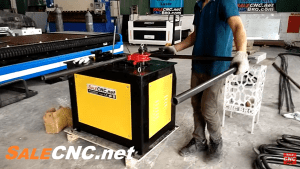
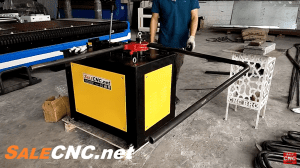
Download Manual for Pipe Bending Machine WG Series Click Here
Machine Display Interface

Example Operation Video
Main Performance And Characteristics (Overview)
The WG-38/-50/-75 CNC pipe bending machine is primarily used for bending various steel pipes and stainless steel pipes of different materials and diameters. Compared to existing pipe bending machines on the market, it offers the following advantages:
- Efficient pipe bending
- Durable and easy-to-maintain gear transmission
- Cost-effective for bending both thick and thin tubes
- Pedal + CNC operation for quick and reliable use
Machine Structure

- Gearbox
- Motor
- Gearbox pulley
- Motor pulley
- Belt
- Walking wheel
- Bearing flange (including clutch plate)
- Turning wheel
- Rotary spring
- Shutdown swing arm
- Encoder connection tube
- Foot switch
- Encoder
- Encoder bracket plate
- Stop switch
- Trip switch holder
Machine Installation, Debugging, and Operation
• Pre-Installation Checks:
- Verify all machine parts and electrical components are complete and undamaged after transport.
- Ensure the machine is installed on a level surface to prevent operational vibration and damage to components.
• Power On Procedure:
- After careful inspection, connect the power source to the terminal.
- Turn on the controller power switch. (Note: The machine requires a stable ground connection. Use a national standard copper cable of at least 6 square millimeters for power supply within 50 meters, and install a leakage protection switch.)
• No-Load Test:
- Upon powering on the controller, a normal digital display should appear. If not, check for power phase issues or voltage irregularities.
- Set an arbitrary angle (5-200°) via the operation steps. Depress the foot switch to verify motor direction. If reversed (no normal display on the controller), switch the wiring. The motor should rotate clockwise during bending and counterclockwise during retraction.
• Load Test:
- Preparation: Install the appropriate bending dies (inner wheel, guide strip, etc.) based on the pipe diameter and desired curvature. Adjust the clamping device to the correct position.
- Pipe Clamping: Set the fixed length device according to the required pipe length and securely clamp the steel pipe.
- Angle Setting: Configure the bending angle using the control panel as per the user guide.
- Bending Operation: Depress the foot pedal switch sequentially to bend to the set angle. Release the clamping device. Repeat steps 2 and 4 for subsequent bends or to remove the finished pipe.
- Angle Correction: If the actual bent angle deviates from the set angle, perform angle correction as described in the control panel guide.
- Production Run: Repeat steps 2 and 4 to process multiple pieces, enabling mass production.
Equipment Safety, Maintenance, and Care
1) Safety Precautions:
- Read this manual thoroughly before installation and operation. Strict adherence to precautions and instructions is mandatory for operator safety and equipment integrity.
- Do not tamper with or modify safety devices. Keep clear of moving parts and the motor. Avoid contact with processed pipes. Unauthorized attachments are prohibited.
- Always disconnect the main power supply before performing any maintenance to prevent electrical hazards.
2) Maintenance and Care:
- Refer to this manual for maintenance procedures. Protect the equipment from environmental elements (rain, sun, dust) when used outdoors. Ensure main power is disconnected before maintenance.
- Unauthorized disconnection of the power switch during operation can lead to equipment damage.
- For prolonged storage: Disconnect main power, secure all components, cover the machine, and apply anti-rust oil to susceptible areas.
- Routine Maintenance Schedule:
- End of Shift/Start of Shift: Clean the equipment, removing iron oxide and debris.
- Monthly: Inspect mechanical components for oil leaks or looseness; address immediately. Check gearbox for lubrication.
- Weekly: Ensure control systems are clean. Verify all connection lines are secure. Clean dust from control components.
How to Use Pipe Bending Machine WG-38/-50/-75 CNC (Round & Square Pipes) | SALECNC.net
0:15 Demonstration of Round Steel Pipe Bending
0:50 90-Degree Pipe Bending
1:39 Characteristics of Bent Pipes
1:50 Machine Setup and Operation Tutorial
Changing Molds (Round & Square) on Pipe Bending Machine | SALECNC.net
Sample Workpieces


Bending Structural Steel Pipes for Roof Trusses Using a Pipe Bending Machine



 salecnc.net
 salecnc.net
 salecnc.net


