














 Back to M14-เครื่องดัดท่อ (Pipe Bending)
Description
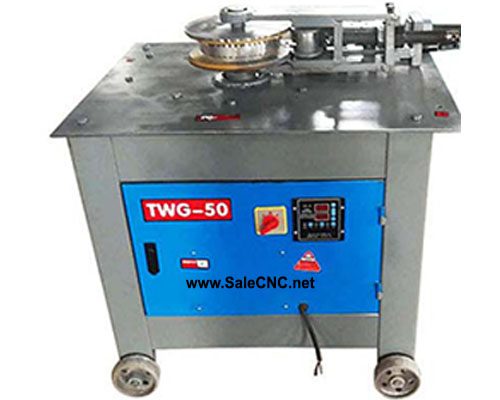
Pipe Bending Machine Model TWG-50

| Model: TWG-50 | Machine Specifications |
|---|---|
| Motor Power | 3 KW. |
| Voltage | 380 VAC 50 Hz (3 Phase) |
| Bendable Steel Pipe Diameter | 16-51 mm (0.5 – 2 inches) Maximum wall thickness: 3 mm. |
| Bendable Angle | 5 – 180 degrees |
| Bend Position Memory | 9 Positions |
| Weight | 310 KG. |
| Machine Dimensions (L x W x H) | 930 x 680 x 850 mm |
| For more details, please contact: Tel. 082-9729329 (Mee) | |
R x3 , Example OD35 35/2*3= R52.5mm
Other Model Comparison Table
| Model | TWG-25 | TWG-38 | TWG-50 | TWG-75 | TWG-75 Hi-Speed |
|---|---|---|---|---|---|
| Motor Power | 2.2 Kw | 2.2 Kw (6 Pole Motor) | 3 Kw | 4 KW. (4 Pole Motor) | 4 KW. (4 Pole Motor) |
| Voltage | 380 VAC 50 Hz (3 Phase) | ||||
| Bendable Steel Pipe Diameter | 10-26 mm (0.4 – 1.02 inches) Maximum wall thickness: 2 mm. |
16-38 mm (0.5 – 1.5 inches) Maximum wall thickness: 3 mm. |
16-51 mm (0.5 – 2 inches) Maximum wall thickness: 3 mm. |
Max. 76 mm (3 inches) Maximum wall thickness: 2-3 mm. |
Max. 76 mm (3 inches) Maximum wall thickness: 2-3 mm. |
| Bend Angle | 5 – 180 degrees | ||||
| Bend Position Memory | 10 Positions | 9 Positions | |||
| Weight | 180 KG. | 230 KG. | 310 KG. | 630 KG. | 630 KG. |
| Machine Dimensions (L x W x H) | 800 x 650 x 900 mm | 900 x 800 x 850 mm | 930 x 680 x 850 mm | 940 x 750 x 850 mm | 940 x 750 x 850 mm |
| Other | Hi-Speed: 3-5 rpm
(Motor spindle speed) |
||||


Download Manual for Pipe Bending Machine WG Series Click Here
Machine Display

Example Operation Video
Main Performance And Characteristics (Overview)
The WG-38/-50/-75 CNC Pipe Bending Machine is primarily designed for bending various steel and stainless steel pipes of different diameters and materials.
Compared with existing pipe bending machines in the market, it offers the following advantages:
- Efficient pipe bending.
- Durable and easy-to-maintain gear transmission.
- Cost-effective for bending both thick and thin wall tubes.
- Pedal and CNC operation for quick and user-friendly control.
Machine Structure

- Gearbox
- Motor
- Gearbox Pulley
- Motor Pulley
- Belt
- Walking Wheel
- Bearing Flange (including clutch plate)
- Turning Wheel
- Rotary Spring
- Shutdown Swing Arm
- Encoder Connection Tube
- Foot Switch
- Encoder
- Encoder Bracket Plate
- Stop Switch
- Trip Switch Holder
Machine Installation, Debugging, and Operation
• Pre-installation Checks:
- Before installation and use, verify that all machine parts and electrical components are intact and check for any loose or damaged screws incurred during transportation and handling.
- Ensure the machine is installed on a level surface to prevent operational vibration and potential damage to components or electrical systems.
• Power On Procedure:
- After thorough inspection, connect the power source to the designated terminal.
- Activate the controller power switch.
Note: The machine must be placed on a stable, level surface. The power cable should be a minimum of 6 sq. mm. copper cable (national standard) and used within 50 meters. A leakage protection switch is mandatory.
• No-Load Test:
- Turn on the power and then activate the controller power switch. A normal digital display should appear on the controller. If not, check for phase issues, voltage abnormalities, etc.
- Perform an arbitrary angle setting (between 5° and 200°) as per “Operation Step 3 Angle Setting Operation.” Depress the foot switch to check motor direction. If the motor reverses (indicated by no normal digital display), reverse the electrical connections. The motor should rotate clockwise during bending and counter-clockwise during retraction.
• Load Test:
- Preparation: Select and install the appropriate bending die (inner wheel, guide strip, etc.) according to the pipe diameter and required curvature. Adjust the pinch device to the correct position.
- Pipe Securing: Set the fixed length device according to the required length of the pipe to be bent and securely clamp the steel pipe.
- Angle Setting: Set the desired bending angle using the control panel as per the “Control Panel Easy Description.”
- Bending Operation: Depress the foot pedal switch step-by-step to bend the pipe to the set angle. Release the clamping device after each bend. Repeat “Operation Step 2) Pipe Securing” and “Operation Step 4) Bending Operation” as needed.
- Angle Correction: If the actual bent angle deviates from the set angle, perform angle correction as described in the “Control Panel Easy Description.”
- Mass Production Setup: After successful testing and angle verification, repeat “Operation Step 2) Pipe Securing” and “Operation Step 4) Bending Operation” to prepare for mass production.
Equipment Safety, Maintenance, and Care
1) Safety Precautions:
- A. Manual Review: Thoroughly read this manual before installing and operating the equipment. Strict adherence to the precautions and operating instructions is crucial for operator safety and optimal equipment performance.
- B. Operational Safety: Do not tamper with or modify any switches or safety devices. Avoid proximity to the motor and moving parts. Do not touch the workpiece during processing. Do not install unauthorized objects on the equipment.
- C. Maintenance Safety: Ensure all power supplies are disconnected before performing any maintenance to prevent electrical hazards.
2) Equipment Maintenance and Care:
- A. General Maintenance: Follow manual instructions precisely during maintenance. If operating outdoors, protect the electrical control system from rain, sun, sand, and dust. Always disconnect the main power before maintenance.
- B. Operational Interruption: Do not disconnect the power switch while the device is running, as this can cause damage.
- C. Long-Term Storage: Disconnect the main power supply, place components in a non-working state, cover the equipment with a protective cloth, and apply anti-rust oil to susceptible areas.
- D. Regular Routine Maintenance:
- End of Shift/Start-up: Clean the equipment to remove iron oxide and debris.
- Monthly: Inspect mechanical parts for oil leaks and looseness; address any issues immediately. Check for grease in the gearbox.
- Weekly: Ensure control devices are clean. Check for loose connections and clean dust from all control components.
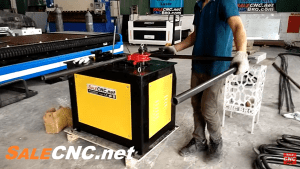
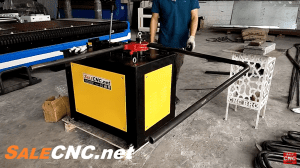
How to Operate Pipe Bending Machine WG-38/-50/-75 CNC (Round & Square Pipes) | SALECNC.net
0:15 Demonstrating Round Steel Pipe Bending
0:50 Bending Pipe at 90 Degrees
1:39 Characteristics of Bent Pipes
1:50 Tutorial on Machine Setup and Operation
Changing Bending Molds (Round & Square) on Pipe Bending Machine | SALECNC.net
Workpiece Samples


Bending Structural Steel Pipes for Roofing with Pipe Bending Machine



 salecnc.net
 salecnc.net


