












 Back to Packaging Machines
Automatic Carton Folding and Packing Machine SJ-30T
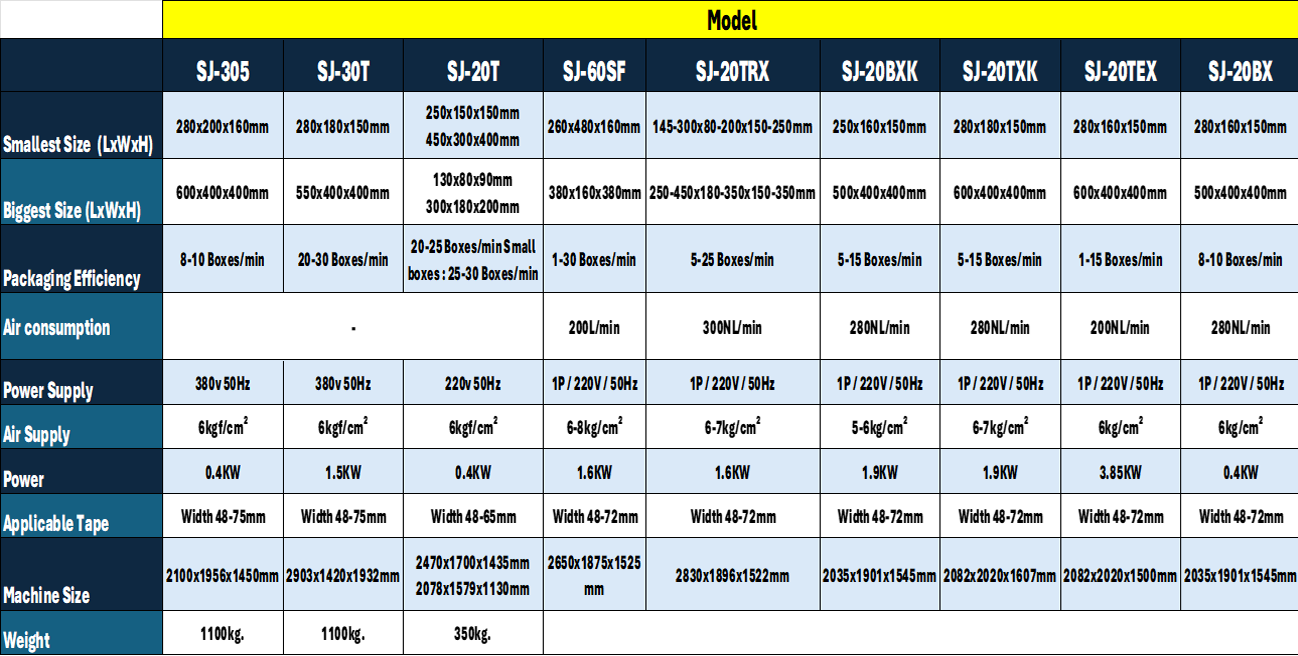
Smallest Size (LxWxH): 280x180x150mm
Biggest Size (LxWxH): 550x400x400mm

Frequently Asked Questions (FAQ)
Bottom Sealing by Air Blowing
A : The thickness of the carton is more than 5 layers, and the crease should be deep.
B : The crease of the blade length, with a shore level of 5 or more in the carton, should be one carton thickness greater than the crease of the blade in the front chamber.
Side A (Front of Carton)
A : Side A refers to the front side of the carton that will be engaged by the suction cups of the carton opener.
B : The printing orientation of Side A dictates the placement of product information and the carton’s bottom.
C : Side A indicates the front of the carton, providing directional and informational cues.
D : The machine features a simplified operation model, adaptable for left or right-hand processing.
E : The material should not be excessively soft, and the surface must be flat, especially crucial for high-speed carton unpacking operations requiring optimal sample feed.
Material Specifications
A : Materials that are too soft or have irregular surfaces can impede machine performance. Optimal material characteristics contribute to increased operational speed. Provide materials that meet these specifications whenever possible.
B : Training and sample information should be provided for materials exceeding 5 layers in thickness.
Scoring/Cutting
A : For all carton materials, scoring the corners is recommended, particularly for cartons exceeding 5 layers or requiring high-speed processing.
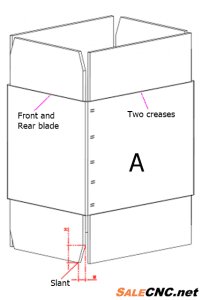
B : The purpose of diagonal scoring is to prevent non-standard folding or creasing of the paperboard, which could negatively impact subsequent opening and forming processes.
C : The position of the diagonal score, as illustrated, is approximately one-third the height of the front and rear flaps, relative to the carton thickness.
Blade Specifications
A : When the two outer blades are manually folded and flattened, they must not overlap. Ensure a gap of 1-2 mm is maintained.
B : When folded in half, the front and rear inner blades also must not overlap.
C : The inner and outer blades are slightly square. The two manufactured outer blades are always uniform in size and require oblique cutting for proper shaping.
Carton Sizing
A : For unpacking machine planning, it is advised to provide a comprehensive list of all carton specifications (length, width, and height) for reference.
B : For square cartons, pay close attention to the ratio of length to fixed height, ensuring it does not become excessively large.
C : For large or small cartons, it is generally not feasible to use the same mechanism to effectively handle cartons with significant dimensional variations.
Features
✅ The equipment is designed and manufactured to meet the requirements of production line process flow and plane layout, exhibiting an aesthetically pleasing appearance and robust manufacturing technology.
✅ Low electricity and water consumption, offering ease and speed in operation, adjustment, and maintenance.
✅ Capable of sealing with or without tape, and includes a cardboard box alarm function.
Storage Box Mechanism
Approximately 50 unformed cartons can be loaded at one time (depending on carton thickness), with the ability to replenish at any time.
Electrical Configuration
✅ PLC Control: German “Siemens”
✅ Relay/Contactor: French “Schneider”
✅ Button Switch: Siemens APT
✅ Human-Machine Interface: China “Xinjie”
✅ Cylinder: Taiwan “Airtac”
✅ Motor: Taibang
✅ Vacuum Generator: Japan SMC
Work Flow
Suction Box – Unpacking – Fold Front and Rear Flaps – Fold Left and Right Flaps – Seal Bottom
Environmental Conditions
✅ Humidity: ≤98%
✅ Temperature: 0-40℃
 salecnc.net

 salecnc.net


